


Most couples who book me have never seen a live wedding painting happen in person. They have watched a reel. They know the end result. But they have no idea what goes on between when I walk in with my easel and when they see the finished canvas.
This is that guide. Every step, in plain language, from the first conversation to the moment you hold the painting in your hands.
Step One — The Conversation Before the Wedding
Everything starts here. Before I agree to a booking, I need to understand your wedding properly. Not just the date and city the actual shape of your day.
I will ask you which moment you want painted. The varmala, the pheras, the first dance, a sunset portrait each of these requires a different kind of preparation and a different position at the venue. Some moments last three minutes. Some last forty. The painting I make in each case looks and feels completely different.
I will also ask about the venue layout, the lighting situation, whether the ceremony is indoors or outdoors, and whether there is a photographer I should coordinate with. A good wedding photographer and a live painter working in awareness of each other produce much better results than two people accidentally getting in each other’s way. If you are still working out your budget, I have written a separate guide on how much live wedding painting costs in India
Step Two — Preparation and Packing
A few days before your wedding, I prepare the canvas. I choose the size we agreed on.
My bag on wedding day contains more than most people expect. Canvas, easel, a full set of Winsor & Newton colours, multiple brush sizes, water containers, palette, clips, and a few things for contingencies: extra palette paper, a torch for low-light situations, tape. DJI Osmo camera for reel shoot. Everything in it has a reason to be there.
Step Three — Arriving at the Venue
I arrive two to three hours before the ceremony begins. This time is not wasted. It is some of the most important time of the day.
I walk the venue. I look at the lighting from different angles, I identify where the couple will be positioned, and I find the spot that gives me the clearest view of the moment I am there to capture. I set up, check that the easel is stable, lay out the colours I will need most, and then I wait, which is less passive than it sounds. I am watching. I am noticing how the light changes as the room fills. I am adjusting my mental composition as the decor comes together in front of me.
By the time the ceremony begins, I am ready. Not just technically ready, visually ready. I already know what I am going to paint and roughly how I am going to paint it.
Step Four — Painting During the Ceremony
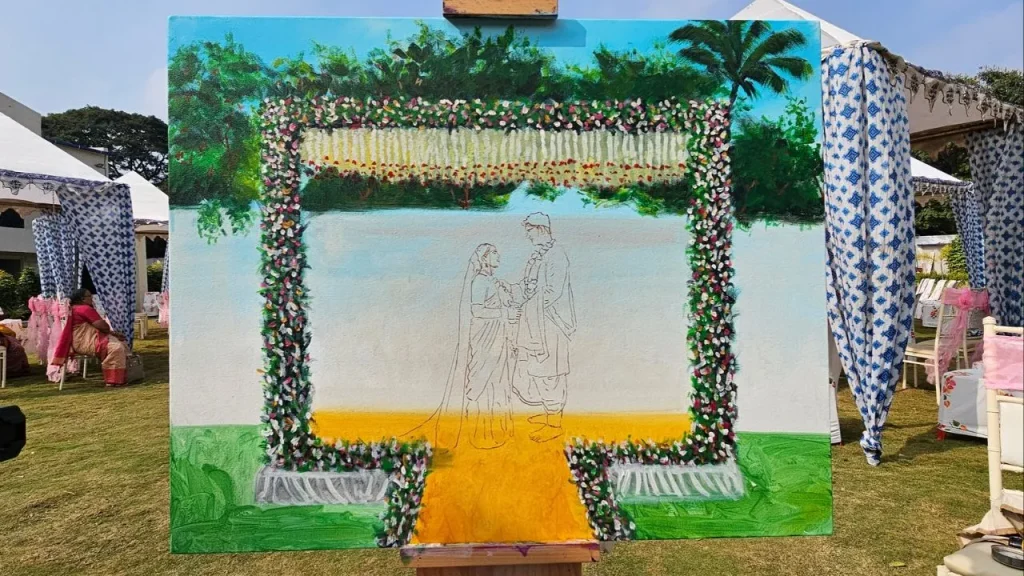
This is the part people are most curious about, and the part that is hardest to explain until you have seen it.
The ceremony is happening. There is enjoyment, movement, emotion, music, a hundred people shifting in their seats. And in the middle of all of that, I am painting.
I start with the background: the mandap, the venue, the structural elements that will not change much as the ceremony progresses. Then I work toward the couple. The composition gets built in layers, not finished left to right. By the time the most important moment happens the garlands going on, the pheras beginning, the first dance I am ready to capture it directly.
I do not paint every detail during the ceremony. That is not how live wedding painting it works and anyone who tells you otherwise is either very fast or not being truthful about the quality. What I capture live is the composition, the likeness, the colour palette, the atmosphere, and the essential gesture of the moment. The painting is recognisably itself by the time the ceremony ends.
Guests will come and look. Some will ask questions. I answer briefly and keep working. It is part of what makes the experience feel alive; watching the painting emerge in real time is genuinely interesting to people, and that energy feeds back into the room in a good way.
Step Five — The Finishing Stage
After the ceremony, I take the painting back and spend two to four hours on finishing work. This is where faces get sharpened, details get refined, and the painting moves from something that reads well at a distance to something that holds up close.
I do not consider this separate from the live painting it is part of the same piece. The live work captures the truth of the moment. The finishing work makes sure that truth is communicated as clearly as possible in the final painting.
Some artists finish entirely on the day. A few do. Most are either painting quickly and sacrificing detail, or they are being creative about what “finished” means. I would rather be honest with you about the process and hand you something genuinely good.
Step Six — The Reveal
This is my favourite part of the whole process, and I say that having done this more than hundred times.
When you see the painting for the first time, something happens that I cannot fully predict or plan for. It is different every time. Some couples go quiet. Some cry. Some laugh. Some do all three in about fifteen seconds.
What I know is that it is real. Nobody is performing for the camera. The moment is its own thing a painting of your wedding, seen for the first time, at your wedding. There is nothing quite like it.
What You Take Home
You receive the original canvas painting. I also provide a high-resolution photograph of the finished work and one complimentary reel for the couple, which you can use for printing, framing, or sharing. The painting itself can be framed before display. I can advise on sizing and framing options if needed.
The painting is yours entirely. I may ask permission to share images and reel of it on my social media, which most couples are happy with, but that is always a conversation and never an assumption.
conclusion
If you are reading this and trying to decide whether live wedding painting is right for your wedding, the simplest way I can describe it is this.
Photography gives you a record of what happened. A painting gives you how it felt. Both matter. They do not compete with each other; they do different things. What you are deciding is whether you want something handmade, one-of-a-kind, and permanent alongside the photographs.
Most couples who have had it say it is the thing they did not know they needed until they saw it in their home. If that sounds like something you want, get in touch here.
